


What Are You Looking For?
Inquiry Now

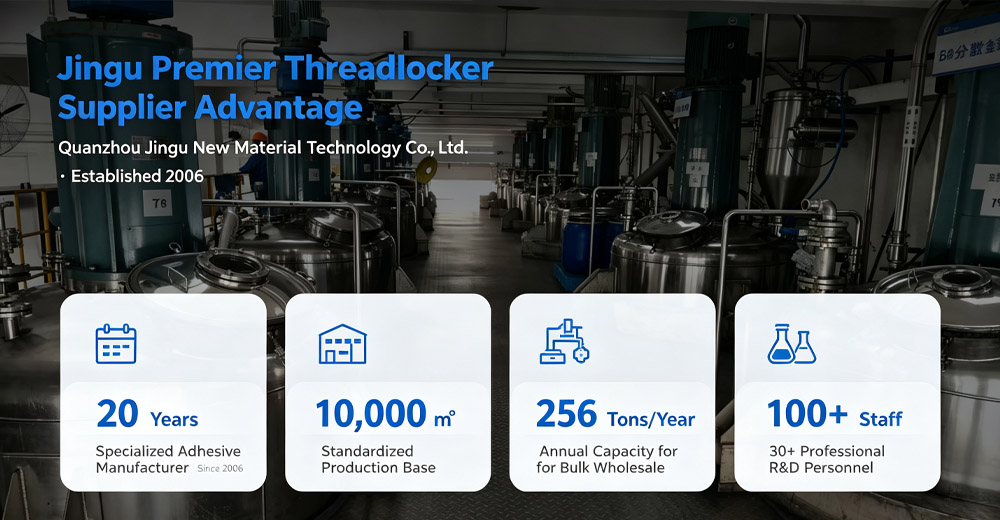
In modern industrial manufacturing and assembly, fastener loosening remains a primary root cause of machinery downtime and safety hazards. Choosing a trustworthy threadlocker supplier is vital for ensuring mechanical connection stability while managing production overhead. As an experienced threadlocker manufacturer, Quanzhou Jingu New Material Technology Co., Ltd. (Jingu) leverages 20 years of adhesive formulation expertise to deliver high-performance anaerobic threadlocking solutions that match global standards like Loctite at competitive wholesale costs.
Quanzhou Jingu New Material Technology Co., Ltd. (Jingu) was established on March 15, 2006, as a specialized industrial adhesive manufacturer. The company maintains a complete quality tracking system from raw material inspection to finished shipment. All products comply with international environmental standards and hold full compliance certifications to guarantee smooth customs clearance and reliable batch delivery for global bulk orders.
| Evaluation Metric | Jingu Factory Capabilities |
|---|---|
| Establishment & Experience | March 2006 (20 years of adhesive R&D and manufacturing experience) |
| Facility & Capacity | 10,000 m² plant area; 256 tons annual threadlocker output |
| Workforce & R&D | 100+ total staff; 30+ senior R&D engineers |
| Quality Certifications | ISO9001 Quality Management & ISO14001 Environmental Management |
| Global Network | Exporting to 150+ countries with OEM/ODM services |
Q: Why choose an ISO-certified threadlocker manufacturer?
A: ISO9001 and ISO14001 certifications guarantee standardized manufacturing processes. Partnering with a certified threadlocker manufacturer ensures consistent batch-to-batch viscosity, cure rate, and torque resistance, mitigating failure risks in critical industrial assemblies.
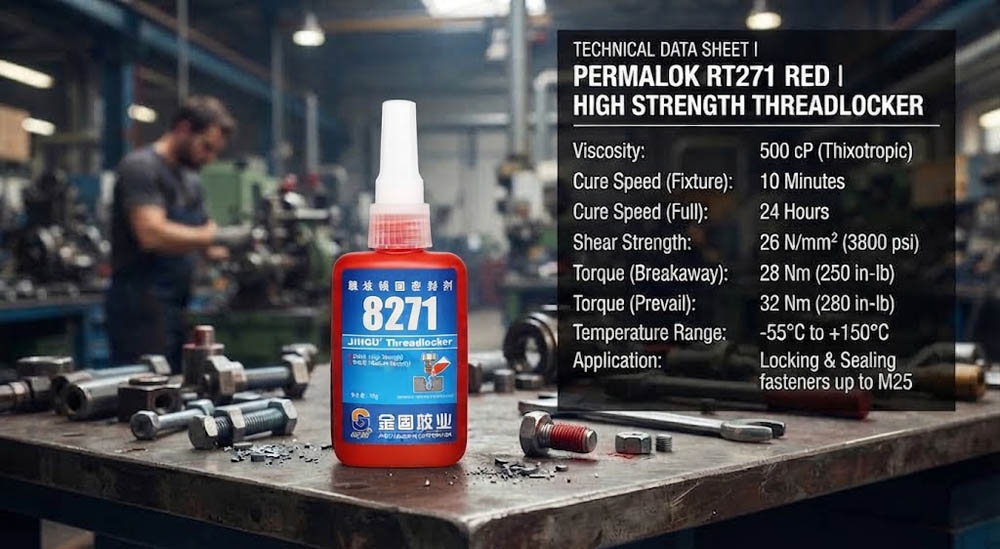
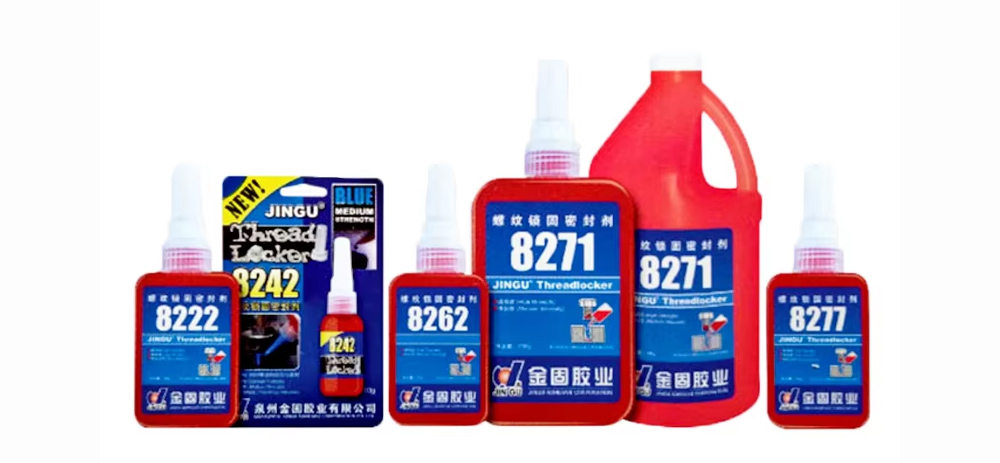
Jingu red anaerobic threadlocking adhesive is specially formulated for locking and sealing metal threaded fasteners. The liquid rapidly polymerizes when deprived of air between closely fitted metal surfaces, forming a tough cross-linked polymer matrix. Its single-component design requires no mixing, making it ready to apply directly to streamline automated assembly lines and field maintenance.
| Performance Metric | Jingu Test Value | Performance Metric | Jingu Test Value |
|---|---|---|---|
| Appearance & Color | Red Liquid | Max Thread Size | Up to M36 |
| Viscosity (mPa·s) | 400 / 600 | Cure Speed (25°C) | 20 min fixture; 24 hrs full |
| Specific Gravity | 1.08 | Recommended Activator | 7649 / 7471 |
| Curing Mechanism | Anaerobic (metal contact) | Temperature Range | -54°C to 150°C |
| Breakaway Torque | 17–40 N·m | Prevailing Torque | 25–40 N·m |
Q: What is the difference between fixture time and full cure time?
A: Fixture time (20 minutes at 25°C) refers to the point where the adhesive achieves initial handling strength so parts can be moved. Full cure time (24 hours) is when the chemical cross-linking reaches 100% of its rated torque resistance and sealing capacity.
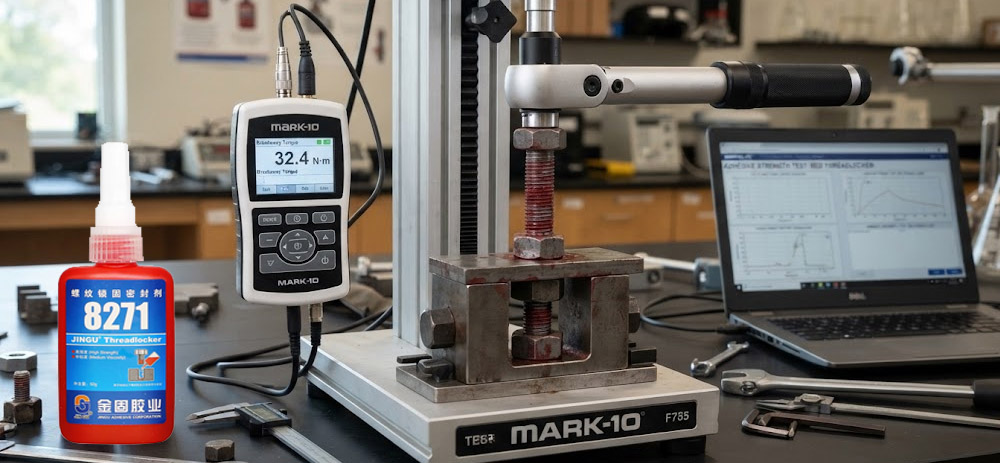
To objectively verify Jingu threadlocker quality in demanding industrial environments, Jingu's central laboratory conducted head-to-head testing against industry benchmark Loctite under ASTM D5363 standards.
The test data confirms that Jingu anaerobic threadlocking adhesives achieve equal mechanical strength, viscosity control, and thermal resistance on metal substrates. Consequently, selecting Jingu as your primary threadlocker supplier enables seamless dual-sourcing or direct brand substitution without sacrificing product reliability.
| Tested Performance Property | Jingu Red Threadlocker | Loctite Benchmark Equivalent |
|---|---|---|
| Color & Viscosity | Red, 400–600 mPa·s | Red, 400–600 mPa·s |
| Specific Gravity | 1.08 | 1.08 |
| Breakaway Torque (M10) | 17–40 N·m | 17–40 N·m |
| Prevailing Torque | 25–40 N·m | 25–40 N·m |
| Fixture / Full Cure Time | 20 min / 24 hrs | 20 min / 24 hrs |
| Recommended Activator | 7649 / 7471 | 7649 / 7471 |
| Temperature Range | -54°C to 150°C | -54°C to 150°C |
| Direct Wholesale Cost | Direct Factory (30%–50% Savings) | High (Premium Brand Markups) |
Q: Can Jingu threadlockers directly replace equivalent Loctite products?
A: Yes. Jingu's chemical formulation, curing mechanism, viscosity (400–600 mPa·s), and shear resistance (disassembly torque 25–40 N·m) fully match Loctite standards, enabling drop-in substitution without altering engineering drawings or assembly line parameters.
Beyond verified product quality, Jingu operates as a direct-source threadlocker manufacturer offering distinct supply chain price advantages. Premium brand markups frequently account for over 40% of adhesive costs. By purchasing directly from Jingu, buyers bypass multi-tier distributor margins to lower adhesive procurement spend by 30%–50%.
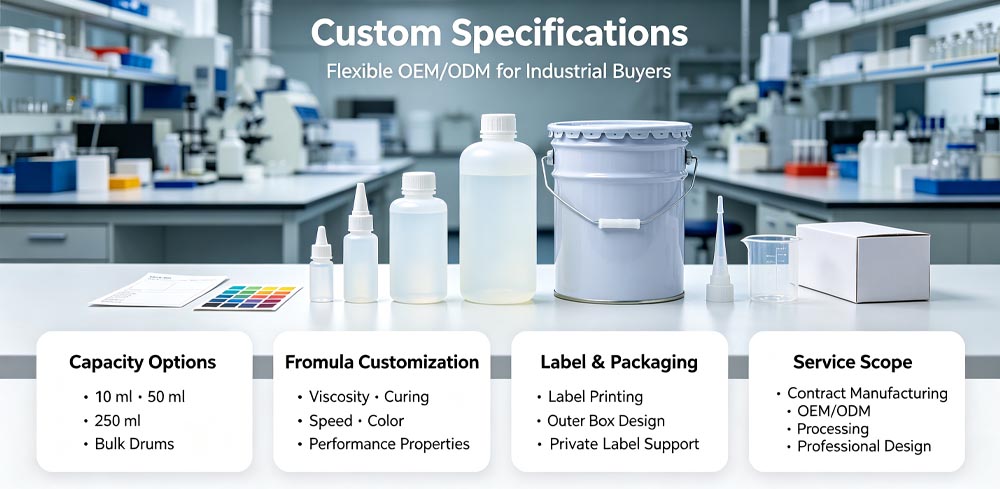
Jingu specializes in tailored contract manufacturing and OEM/ODM services to suit diverse private label and industrial packaging needs:
Backed by a stable annual capacity of 256 tons and established shipping logistics to 150+ countries, Jingu delivers dependable lead times and full traceability for global B2B buyers.
Q: What OEM customization options does Jingu offer? What is the MOQ?
A: Jingu offers custom bottle molding, capacities (10ml to 250ml), custom label printing, and outer box packaging. We provide flexible MOQ terms for B2B wholesale orders along with fast sample dispatch.
To achieve optimal locking and anti-leak performance, adhesive selection should consider thread size, disassembly requirements, and operating conditions:
| Strength Grade | Typical Industrial Application | Recommended Thread Size | Disassembly Requirement |
|---|---|---|---|
| Low Strength | Instrument panels, calibration screws | < M8 | Easy removal with hand tools |
| Medium Strength | Pumps, gearboxes, hydraulic fittings | M8 – M20 | Removable with standard hand tools |
| High Strength (Red) | Engine studs, heavy equipment mounts | M20 – M36 | Heat to 200°C+ before wrench removal |
Q: How do you disassemble high-strength threadlocked bolts?
A: High-strength joints with a 25–40 N·m disassembly torque can be removed by applying a heat gun or torch to heat the assembly to 200°C–250°C. This softens the cured thermoset matrix, allowing clean disassembly with standard wrenches.
Leave A Message